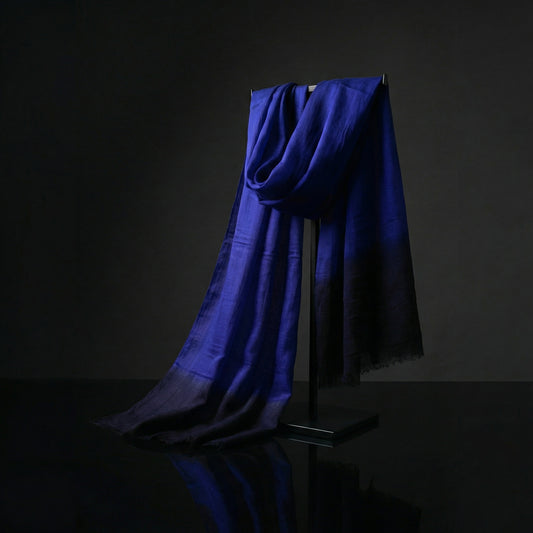
What to Look for When Buying Your First Tagelmust Scarf
What to Look for When Buying Your First Tagelmust Scarf
Buying your first Tagelmust is a different experience from buying most accessories. This is not a garment you pick up impulsively and replace in a season. A good Tagelmust, properly cared for, will accompany you for years — developing character, softening beautifully, and becoming, in the way of well-made things, more itself over time.
The market, unfortunately, includes both exceptional pieces and disappointing ones. This guide gives you the knowledge to tell them apart.
1. Fabric: The Most Important Decision
The fabric of a Tagelmust determines nearly everything: how it feels against your skin, how it breathes, how it drapes when wrapped, and how it ages. This is where most quality differences are found, and where buyers are most often misled.
What to look for
- Natural or semi-natural fibers: cotton, rayon (viscose), silk, or blends of these
- A loose, open weave that allows airflow — you should be able to hold the fabric to light and see through it slightly
- Softness without limpness — quality fabric drapes beautifully but has some body
- No chemical or plasticky smell — natural fibers have a clean, neutral scent
What to avoid
- Polyester or synthetic blends: these trap heat, do not breathe, and completely undermine the cooling function that makes the Tagelmust unique
- Fabrics that feel stiff or crinkle unnaturally — these have often been treated with cheap stiffening agents that will wash out, leaving a disappointing limp cloth
- Fabrics that feel slippery or "plastic-like" — a classic sign of synthetic content
💡 The touch test: run the fabric between your thumb and forefinger. Natural fibers have a slight resistance and warmth. Synthetics feel cool, slick, and uniform. If in doubt, a short Google search of the seller's stated fabric composition will confirm whether it matches what you feel.
2. Length: Choose Generously
First-time buyers almost always underestimate how much they will want from their Tagelmust over time. A shorter piece may feel manageable to begin with, but as you develop different wrapping styles and find new uses for the garment, you will inevitably wish you had chosen longer.
- 2–3 meters: suitable for a simple neck scarf or basic head wrap only — limited versatility
- 3–4 meters: the practical minimum for the classic Tuareg head wrap — recommended for beginners
- 4–6 meters: the most versatile range — allows multiple wrapping styles, face coverage, and use as a light shawl or cover
- 6–10 meters: traditional lengths — maximum versatility, also usable as a light blanket or sleeping cover
If you are unsure, start with 3 to 4 meters. It is manageable for a beginner while offering real versatility. Traditional nomads typically kept 2–3 Tagelmusts: one for everyday use, one for occasions, and sometimes a spare. There is wisdom in not overcomplicating your relationship with the garment.
3. Craftsmanship: Signs of a Well-Made Piece
A handmade or artisan-quality Tagelmust differs from a mass-produced one in ways that are visible if you know what to look for.
Positive signs
- Loose, natural finishing at the ends — traditional Tagelmust ends are often left with loose threads rather than machine-hemmed, as this is considered a sign of authentic handwork
- Even weave with occasional minor variations — slight irregularities in handwoven fabric are a feature, not a defect
- Consistent color absorption with natural depth — indigo-dyed fabric has a depth and variation that synthetic dyes cannot replicate
- Weight that feels proportional — quality fabric has substance without being heavy
Negative signs
- Machine-perfect, identical-thickness edges on all four sides, suggests mass factory production
- Color that looks perfectly uniform and flat — often a sign of synthetic dye applied to synthetic fabric
- Fabric that feels thin or insubstantial for its stated size
- Seller who cannot explain the origin, fabric composition, or dyeing method
4. Dye Quality: Understanding Indigo
If you are drawn to the traditional indigo Tagelmust, and many first-time buyers are, it is important to understand how natural indigo behaves. It releases color in the first several washes. This is completely normal and not a defect. Poorly informed buyers sometimes mistake this for poor quality; it is actually a sign of authentic natural dye.
What you want from an indigo Tagelmust is a deep, rich color with visible variation in the weave, darker and lighter areas that reveal the texture of the fabric. A perfectly flat, even indigo is more likely to be synthetic dye, which does not bleed in the same way but also lacks the depth and beauty of the natural version.
5. Ethical Sourcing: Who Made This?
A Tagelmust that has been made carelessly, by workers paid poorly, in factories that have no connection to Saharan culture, is not actually a Tagelmust in the fullest sense. It is a product that uses the name without the heritage.
When evaluating a seller, ask:
• Where is this made? (Morocco, Mali, Niger, and Algeria are the primary sources of authentic craftsmanship)
• Who made it? (Artisan-made pieces will usually come with some information about the maker or workshop)
• What is the fabric? (A seller who cannot answer this question clearly is not a seller to trust)
• Is this price reflecting genuine craft? (Exceptionally cheap Tagelmusts are almost never authentically made)
💡 At DUNZ, we work with Moroccan artisans who carry forward the craft traditions of Saharan textile-making. Every piece in our collection has a traceable origin and is made with materials and methods that we can honestly describe. We believe you deserve to know exactly what you are buying.
6. A Checklist for Your First Purchase
- Natural or semi-natural fiber confirmed (not polyester)
- Length of at least 3–4 meters for real versatility
- Loose, open weave visible when held to light
- Authentic craftsmanship indicators present (natural finishing, dye depth)
- Seller can explain fabric, origin, and dye method clearly
- Price reflects genuine craft (expect to invest — quality lasts years)
- Care instructions included or available
What to Expect After Your Purchase
Your first Tagelmust will feel slightly stiff and the indigo (if applicable) will be vivid. After the first cold-water wash, it will soften noticeably and the color will settle. After the first few months of wear, you will notice it developing a patina — a soft, slightly faded quality that experienced wearers find more beautiful than new.
This is not wear and tear. It is character. The Tagelmust is one of those rare objects that improves with use — provided you have started with quality.